
Capturing The Rare Triple Galaxy Arch


There are some photos that happen almost by accident. A quick stop on the side of the road. A lucky break in the weather. A moment where everything unexpectedly lines up. And then there are photos that demand months of planning, physical endurance, technical precision, and a willingness to put yourself into environments most people would actively avoid. The final photo might look effortless when it appears online, but behind it sits something much closer to an expedition than a normal photography trip.
For photographer Angel Fux, this wasn’t just another astrophotography project. It became a full-scale alpine operation built around one of the rarest celestial alignments visible from Earth, a phenomenon known as the double Milky Way arch.
For only a handful of nights each year around the March equinox, photographers in the northern hemisphere have the opportunity to witness both visible arms of the Milky Way during the same night. Not simultaneously, but during the same rotation of Earth. Early in the evening, the winter arm stretches quietly across the sky. It appears softer, wider, and less dramatic than the brighter summer Milky Way most people recognize from astrophotography photos. Then, hours later, the summer arch rises from the opposite direction carrying the dense galactic core filled with thick dust lanes, bright star clouds, and glowing nebulae.
The Milky Way itself contains somewhere between 100 and 400 billion stars and spans roughly 100,000 light-years across. When we photograph the bright galactic core during summer, we’re looking toward the dense central region of our own galaxy, where stars become so concentrated that massive dark dust lanes carve visible structures through the sky. The softer winter arm points toward the outer regions of the galaxy where stars are more spread apart, creating a very different appearance.
Even seeing both arches with your own eyes requires near-perfect conditions. Photographing them properly is another thing entirely.
Angel told us that everything has to align at once, the moon phase, the weather, the position of the arches relative to the landscape, and most importantly, skies dark enough for the structures to separate cleanly from the background. The actual shooting window only lasts a few days each year, and in some years weather alone completely erases the opportunity.
And in Europe, darkness itself is becoming harder to find.
According to numerous research, artificial light pollution across the world is increasing at an estimated rate of roughly 10% every year. Scientists studying satellite data and citizen sky measurements found that the night sky is brightening much faster than older satellite estimates originally suggested. One major study led by physicist Christopher Kyba revealed that children born in places where 250 stars are visible today may only be able to see around 100 stars by the time they become adults if current trends continue.
More than 99% of Europeans now live under light-polluted skies. In many major cities, the Milky Way has already become completely invisible to the naked eye. Even remote mountain regions once considered naturally dark are slowly being affected by expanding urban development, ski tourism infrastructure, LED lighting, and increasing atmospheric scattering caused by artificial light sources dozens or even hundreds of kilometers away.

What makes light pollution especially destructive for astrophotography is that it doesn’t behave like a localized glow sitting only above cities. Artificial light scatters through particles and moisture in the atmosphere, bouncing across enormous distances. Blue-rich LED lighting is particularly problematic because shorter blue wavelengths scatter more efficiently through Earth’s atmosphere via Rayleigh scattering, the same physical process that makes the daytime sky appear blue. As cities continue transitioning toward cooler LED systems, astronomers and environmental researchers have warned that the visible spread of skyglow may accelerate even further.
And the effects go far beyond photography.
Studies published in journals like Nature and Frontiers in Ecology and the Environment have linked excessive nighttime lighting to disruptions in migratory bird navigation, insect population collapse, altered predator-prey behavior, and even changes in plant growth cycles. Sea turtles, for example, famously become disoriented by artificial coastal lighting after hatching. Nocturnal pollinators have also shown major behavioral changes under increasing sky brightness, affecting entire ecosystems in subtle ways scientists are still trying to fully understand.
Human health researchers have also raised concerns about the effects of chronic nighttime light exposure on circadian rhythms and sleep cycles. Artificial light at night suppresses melatonin production, which plays a critical role in regulating sleep and biological recovery processes.
For astronomers, both professional and amateur, the consequences are immediate and visible. Several observatories around the world are already reporting increasing difficulty maintaining dark-sky conditions despite being constructed in remote regions decades ago. Even extremely faint celestial phenomena that were once relatively observable are now disappearing behind the growing glow of artificial sky brightness.
That growing loss of darkness is something Angel has been noticing for years in her own work.
Her search for darker skies intensified after photographing beneath the Andes mountains in Peru, home to some of the darkest skies left on Earth. The high altitude, dry air, and minimal light pollution create conditions so clear that the Milky Way can cast visible shadows on the ground during moonless nights.
She told us the sky there felt completely different from Europe. Not just darker, but heavier somehow. More physical. More present above you.
Coming back to the Alps changed the way she approached astrophotography entirely. Every year since, she has pushed higher into the mountains searching for thinner atmosphere, less moisture, and greater distance from the expanding glow of cities below.
Last year she photographed the double arch from Gornergrat in Switzerland at around 3,000 meters above sea level. The image quickly gained attention online and became one of her most technically ambitious projects at the time. But she already knew she wanted to go further.

This year, the goal became Dent d’Hérens.
The mountain rises to just under 4,200 meters and sits directly behind the Matterhorn on the border between Switzerland and Italy. Dent d’Hérens is considered a serious alpine summit even for experienced climbers. Unlike nearby tourist-accessible locations around Zermatt, this mountain remains remote, heavily exposed, and difficult to access during winter conditions.
Photographers almost never go there at night.
Angel told us that the gear required for astrophotography and the gear required for high-altitude climbing are usually completely incompatible. One demands delicate electronics, tracking systems, batteries, lenses, and camera gear. The other requires survival equipment capable of handling dangerous alpine conditions. Combining both worlds meant every kilogram mattered.
To make the expedition possible, Angel worked closely with Swiss mountain guide Richard Lehner. Planning started months before the actual summit attempt. Routes were studied carefully. Weather windows monitored constantly. Backup plans discussed. Helicopter logistics coordinated across international borders.

At one point, the entire project nearly collapsed.
The week surrounding the equinox brought violent winds across Switzerland. Gusts became strong enough to damage infrastructure in alpine regions, including cable cars in Engelberg. At elevations above 4,000 meters, conditions became dangerous enough that Richard postponed the summit attempt entirely.
Then another problem appeared.
March 19 fell on a Catholic holiday in Switzerland, meaning AirZermatt helicopters were restricted from operating non-emergency flights. The already tiny weather window suddenly became even smaller.
Eventually the team worked out a complicated cross-border solution involving both Swiss and Italian helicopter crews. Swiss helicopters would transport them partway before transferring to an Italian team authorized to operate near the summit itself.
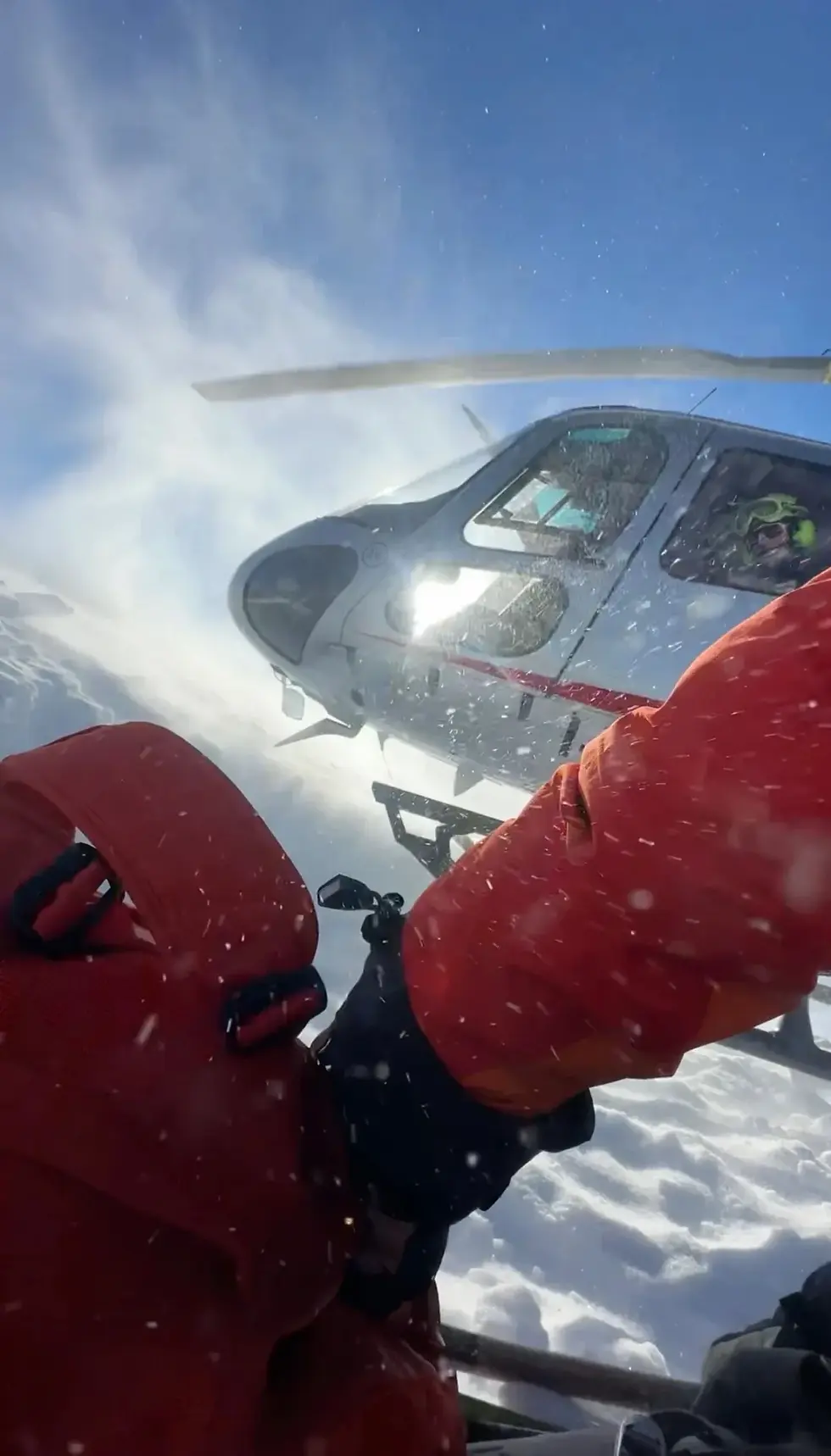
More moving parts. More uncertainty. More opportunities for things to fail.
Meanwhile, Angel spent several days acclimatizing at Gornergrat while testing equipment in freezing conditions. Those test sessions exposed another serious problem.
During one nighttime sequence, her Nikon Z6 II appeared to function normally, displaying captured exposures on-screen exactly as expected. But when she checked the memory card later, none of the files actually existed.
For astrophotographers, that kind of failure is catastrophic.
Large panoramas are built frame by frame over several hours. Lose even one section and entire parts of the final mosaic can become unusable. Cold weather introduces additional challenges because batteries drain dramatically faster, LCD displays become sluggish, and internal electronics can behave unpredictably in extreme temperatures.
Angel told us the issue was apparently linked to mirrorless cameras struggling in severe cold. Eventually she discovered that periodically rebooting the camera solved the problem, but it meant constantly checking files throughout the night rather than fully trusting the equipment.
And the workflow itself was massive.
She shot the project using an astro-modified Nikon Z6 II paired with a Nikkor Z 20mm f/1.8 lens and a Benro Polaris star tracker. The astro modification allowed the sensor to capture much more hydrogen-alpha light than a normal camera. Hydrogen-alpha wavelengths are critical in astrophotography because they reveal glowing emission nebulae scattered throughout the Milky Way, massive clouds of ionized hydrogen gas where new stars are actively forming.

The star tracker played an equally important role.
Because Earth rotates, stars begin to blur during long exposures unless the camera physically rotates with the night sky. The Benro Polaris compensated for Earth’s movement by tracking the stars precisely during each exposure. Without tracking, exposures would need to remain short, dramatically limiting the amount of faint detail visible in the Milky Way.
But tracking creates another technical challeng, while the camera follows the stars, the mountains below remain stationary. That means the sky and foreground eventually need to be blended together manually during post-processing.
The amount of data quickly became enormous.
The winter arch panorama alone required 17 separate panels. The summer arch needed another 16. Each panel consisted of four tracked 40-second exposures stacked together to reduce noise and increase faint detail visibility. Additional hydrogen-alpha exposures were captured using a 12nm filter to isolate nebula structures hidden deep inside the galaxy. Then came another 32 landscape frames captured separately during nautical twilight for the mountains themselves.
In total, the project grew to nearly 300 gigabytes of raw data.
And none of that included the actual conditions on the summit.
On March 19, Angel, Richard Lehner, and his son Arnaud finally flew onto Dent d’Hérens.
Angel told us that the moment the helicopter disappeared into the darkness, the reality of the situation settled in immediately. There was no easy way down until morning.
Temperatures initially hovered around minus 18 degrees Celsius before worsening overnight as strong winds intensified across the ridge, pushing effective temperatures closer to minus 28. At that altitude, even simple tasks become physically exhausting because oxygen levels are significantly lower than at sea level. Studies show that at elevations around 4,000 meters, oxygen availability drops by roughly 40%, slowing reaction times and increasing fatigue.
Every movement became slower. Every camera adjustment required removing gloves briefly while fingers rapidly lost sensation in the freezing wind.
The summit itself remained dangerous enough that Angel stayed attached to ropes whenever she stepped outside the tent. Massive snow cornices surrounded sections of the ridge — overhanging masses of wind-formed snow capable of collapsing under body weight without warning.
Still, the sky delivered.
The winter arch appeared first, stretching softly across the darker half of the night sky. Hours later, the summer arch emerged above the Matterhorn carrying dense star clouds, dark dust lanes, and bright nebulae surrounding the galactic center.
Then something unexpected appeared.
While reviewing panorama files on location, Angel noticed a faint oval glow crossing the sky opposite the Sun’s position. At first it looked subtle enough to dismiss as atmospheric haze or processing artifacts. But it remained visible throughout multiple exposures.
She had accidentally captured the Gegenschein.

Also known as the “counterglow,” the Gegenschein is one of the faintest natural optical phenomena visible in the night sky, and understanding why it appears requires looking at the structure of our solar system itself.
Space between the planets is not empty. It’s filled with microscopic dust particles left behind by asteroid collisions and comet debris over billions of years. This dust forms a vast flattened cloud concentrated roughly along the plane of the solar system, known as the zodiacal dust cloud.
As sunlight travels through the solar system, it strikes these particles from every direction. Most of the time this creates the faint zodiacal light visible before sunrise or after sunset — a diffuse triangular glow extending upward from the horizon. But directly opposite the Sun from Earth’s perspective, something special happens.
At that exact point, the geometry of light scattering changes.
The dust particles begin reflecting sunlight back toward Earth almost directly along the incoming light path, a process known in physics as backscattering or coherent backscatter enhancement. Some scientists also describe part of the effect through a phenomenon called “shadow hiding,” where shadows cast by individual dust grains effectively disappear when viewed directly opposite the light source. Combined together, these effects produce a faint localized brightening in the night sky: the Gegenschein.
The phenomenon is incredibly subtle. Under anything except extremely dark conditions, it disappears completely into background skyglow. Even many experienced skywatchers never notice it visually.
Photographing it cleanly is even harder because the signal itself is so faint compared to artificial light pollution and atmospheric scattering. Capturing it from Europe at all has become increasingly difficult over the years.
At 4,200 meters above sea level, beneath unusually dark alpine skies, it finally revealed itself.
The planned double arch had become a triple arch.
What followed afterward was nearly as exhausting as the expedition itself.
Instead of processing normal RAW files inside Photoshop, Angel handled the project entirely through FITS astronomical data files, a scientific image format widely used in professional astronomy because it preserves far greater dynamic range and data precision than traditional photography workflows.
Each panorama panel was stacked inside PixInsight, one of the most advanced astronomical imaging platforms available. The stitched FITS mosaics were then assembled inside AstroPixel Processor, one of the few applications capable of handling panoramic FITS mosaics at this scale.

Only after calibration, stacking, alignment, gradient removal, and noise reduction could the actual image finally begin to emerge.
Angel told us the first ten hours involved almost nothing visual at all. Mostly histograms, calibration scripts, processing tools, and lines of data. For someone used to traditional visual editing workflows, the process became deeply disorienting.
Forty hours later, the final panorama finally came together.
The Matterhorn now sits beneath three separate celestial structures crossing the night sky: the bright summer Milky Way arch, the pale winter arm, and the faint Gegenschein glowing between them.

It’s not just visually rare. It may genuinely be one of the only photographs ever captured showing all three phenomena together from that altitude and perspective in a single frame.
And according to Angel, reproducing it may already be becoming harder.
Even at 4,200 meters above sea level, the glow from northern Italy remained visible throughout parts of the night. Scientists studying artificial sky brightness have warned that alpine regions once considered naturally dark are increasingly affected by distant urban lighting scattered through the atmosphere.
The Alps themselves have become a growing focus in dark-sky conservation discussions. Researchers monitoring European mountain regions have found that snow-covered terrain can actually amplify skyglow because snow reflects artificial light back upward into the atmosphere, increasing brightness during winter months. Ski resorts, illuminated infrastructure, and expanding tourism development continue pushing artificial light deeper into previously dark alpine valleys.
That matters for more than photography.
Astronomers have repeatedly warned that light pollution affects ecosystems, migratory animals, insect populations, human sleep cycles, and scientific observation itself. Some observatories around the world are already struggling with increasing sky brightness despite being built in remote regions decades ago.
The final image feels suspended between two realities.
On one side, it’s a technical achievement built through months of planning, modern astronomical imaging techniques, and physical endurance at extreme altitude. On the other, it documents something increasingly fragile, genuinely dark skies.
And for Angel, that’s part of why the image matters so much.
She told us that when she first explained the expedition to her parents, they struggled to understand why anyone would risk going somewhere like that simply for a photograph.
But when she returned safely and showed them the final image, their reaction changed completely.
The first thing they asked for was a large print.
Comments